

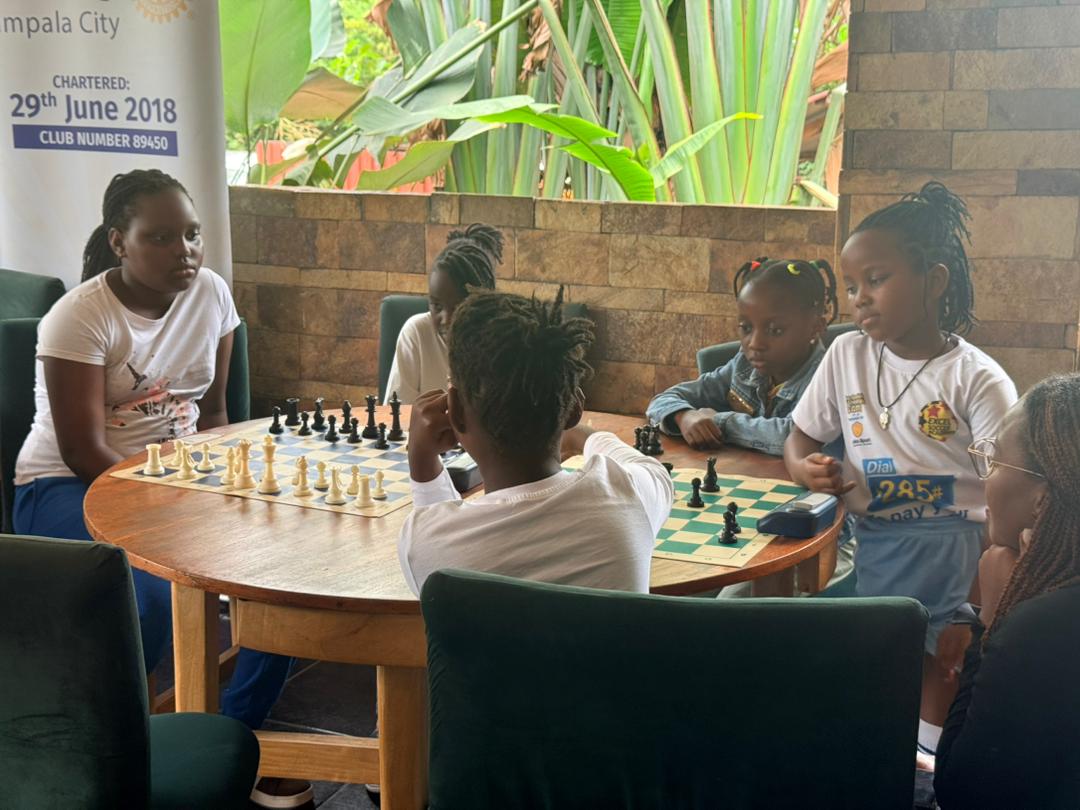
The Rotary Club of Kampala City has organised a children’s chess tournament aimed at promoting critical thinking, concentration and intellectual development among young learners in Kampala.
The event, held over the weekend, brought together 22 children aged between four and twelve years and was organised in partnership with the Camp Life Children’s Initiative Uganda.
Organisers said the initiative seeks to encourage children to develop strategic thinking skills through chess while also providing families with opportunities to engage in educational recreational activities.
Speaking during the tournament, the club’s president, Evasta Kahunde Bugeiga, said the event was designed to introduce children to the benefits of chess and inspire them to develop problem-solving abilities.
“We chose chess because it helps our children develop critical thinking and understand that every move has a consequence,” Bugeiga said.
She explained that while many children actively participate in physical sports such as football, swimming and tennis, mind-stimulating games like chess are often overlooked despite their educational benefits.
“It’s not just about having fun. Chess enhances memory, improves the mind and strengthens children’s ability to think critically and plan their moves,” she said.
Bugeiga said the tournament is the first of its kind within the Rotary fraternity to involve children whose parents are members of Rotary clubs.
According to her, the initiative also aims to help children appreciate the role their parents play in community service.
“This is to show children that when their parents attend Rotary activities, it is not just about being away from home. Rotary also cares about the wellbeing and development of families and children,” she said.
During the competition, participants competed in three categories, with the best performers receiving gold, silver and bronze medals.
Bugeiga said the competition was designed not only to reward excellence but also to teach children important life lessons such as resilience, patience and determination.
“We are teaching these children that you can lose today and win tomorrow. When you improve your skills, you will eventually succeed,” she said.
She added that exposure to tournaments helps children build confidence and could encourage them to participate in other competitions at higher levels in the future.
Bugeiga acknowledged that convincing parents to embrace chess as a sport can sometimes be challenging because many families tend to prioritise physical games.
However, she said parents should strive to balance physical activity with intellectual games that strengthen children’s cognitive abilities.
“As parents we must find a middle ground. Children need physical activities like football and swimming, but they also need games that sharpen their thinking,” she said.
She also called on schools to introduce chess as part of extracurricular activities, saying the game is affordable and accessible.
“Chess should be taught in schools because it improves a child’s tactical thinking and concentration, yet it requires very few resources,” Bugeiga said.
Supporting the initiative, Innocent Agaba, a caregiver with Camp Life Children’s Initiative Uganda, said the chess boot camp aims to nurture young talent and introduce children to the game at an early age.
Agaba said many schools focus heavily on sports like football and volleyball while paying little attention to mind-building games such as chess.
“We felt this initiative was necessary because there is a lot of focus on other sports in schools, but not enough emphasis on chess, especially for younger children,” he said.
According to Agaba, the programme targets children as young as three or four years, as early childhood is a crucial stage for developing mental and learning skills.
“Our target is to start right from the grassroots. Even a four-year-old can begin learning how to move pieces on the chessboard,” he said.
He said the tournament demonstrated that young children can quickly grasp the game and develop strong analytical skills.
Agaba explained that chess helps children improve their ability to focus, listen and analyse situations carefully.
“Chess helps children develop concentration and discipline, which are important skills not only in sports but also in academics,” he said.
He added that the game also teaches children how to accept both victory and defeat while learning from their mistakes.
“One of the lessons chess teaches is that there is always a winner and a loser, but there is also another opportunity tomorrow to improve,” Agaba said.
He encouraged parents, guardians and schools to introduce chess to children at an early age, saying the skills acquired through the game can shape their future development.
The organisers expressed optimism that the tournament will grow in the coming years and attract more participants as awareness about the benefits of chess continues to increase.
Bugeiga said the club hopes to make the event an annual children’s chess tournament in Kampala.
“We hope this will become a yearly event and that next year it will be even bigger and better,” she said
